Cell & gene therapies
Living medicines are fragile, variable and difficult to move. We work on the preservation, handling and manufacturing steps that determine whether an advanced therapy can make the journey from production to patient.

We work at the intersection of academia and industry, bringing together scientists, clinicians, doctors, engineers, chemists, manufacturers, business leaders and investors to turn academic breakthroughs into real-world solutions, ultimately working towards a centre of excellence for the field.
Moving an idea from a laboratory into a clinic, company or real-world system takes more than a good experiment. It needs the right people, evidence, engineering, processes, standards, finance and route to delivery. We help connect those pieces.
Deep expertise in low-temperature biology gives us a practical lens on some of the hardest problems in modern biotechnology — from fundamental freezing science to therapies, tissues, manufacturing and delivery.
Living medicines are fragile, variable and difficult to move. We work on the preservation, handling and manufacturing steps that determine whether an advanced therapy can make the journey from production to patient.
Freezing begins with physics. Understanding when ice forms, how it grows and what happens during cooling and thawing lets us diagnose failure and design better biological processes.
We improve cryoprotectants, media composition and biological preconditioning to increase recovery, reduce toxicity and make freezing more reliable across different biological systems.
As biology becomes larger and more organised, preservation becomes harder. Our work spans ovarian tissue, thymus, neural cells and complex biological systems where structure and function both have to survive.
A method that works in one vial is not yet a product. We work across scale-up, manufacturing, storage, transport and clinical delivery — including the challenges of moving from microlitres to litre-scale systems.
Biobanks protect irreplaceable material for years or decades, but ultra-low-temperature storage carries a substantial energy, infrastructure and environmental burden. We explore how storage and cold-chain practice can become more sustainable without compromising sample quality.
The most difficult translational problems rarely belong to one field. Kyros Kairos is built to connect expertise across academic, clinical, engineering, industrial and financial boundaries.
Kyros Kairos brings experience from both sides of the research-to-application divide: developing science, building processes, working with industry and helping define what good practice looks like.
Peter is a Governor of the Society for Cryobiology, Secretary of the Society for Low-Temperature Biology and founder of the Oxford Cryobiology Group. These roles help keep Kyros Kairos connected across a small, highly international field and between academia and industry.
Contributions across ISO, ISBER, ANSI and PDA initiatives give us a close understanding of how evidence becomes best practice — and how robust standards can help new science become reproducible, transferable and usable.
We have supervised around seven PhD students and supported researchers across cryobiology, cell therapy, tissue preservation and translational science. Collaborations have included the Universities of Leeds, UCL, Manchester and Warwick, alongside wider international partners.
Experience spans around a decade in industry and six years in academia — including GE Healthcare and Cytiva, and university research at UCL and Oxford — and now a small SME designed to move quickly and challenge problems from the bottom up.
Our work has always been international. We have collaborations across Europe, including in Spain, France, the Netherlands and Belgium, and have spent extended periods working alongside researchers at ICFO in Barcelona and INRIA in Paris. In South America, we have spent several months working with the Universidad Nacional de La Plata in Argentina. In the United States, our network includes collaborators at Sylvatica Biotech in South Carolina and groups working across cryobiology, preservation and regenerative medicine. Across the UK, we have worked widely with universities, hospitals — including Addenbrooke's Hospital in Cambridge — industry and major life-science companies. Cryobiology is a small, highly connected field, and we see these international relationships as vital to moving the science forward and building what comes next.
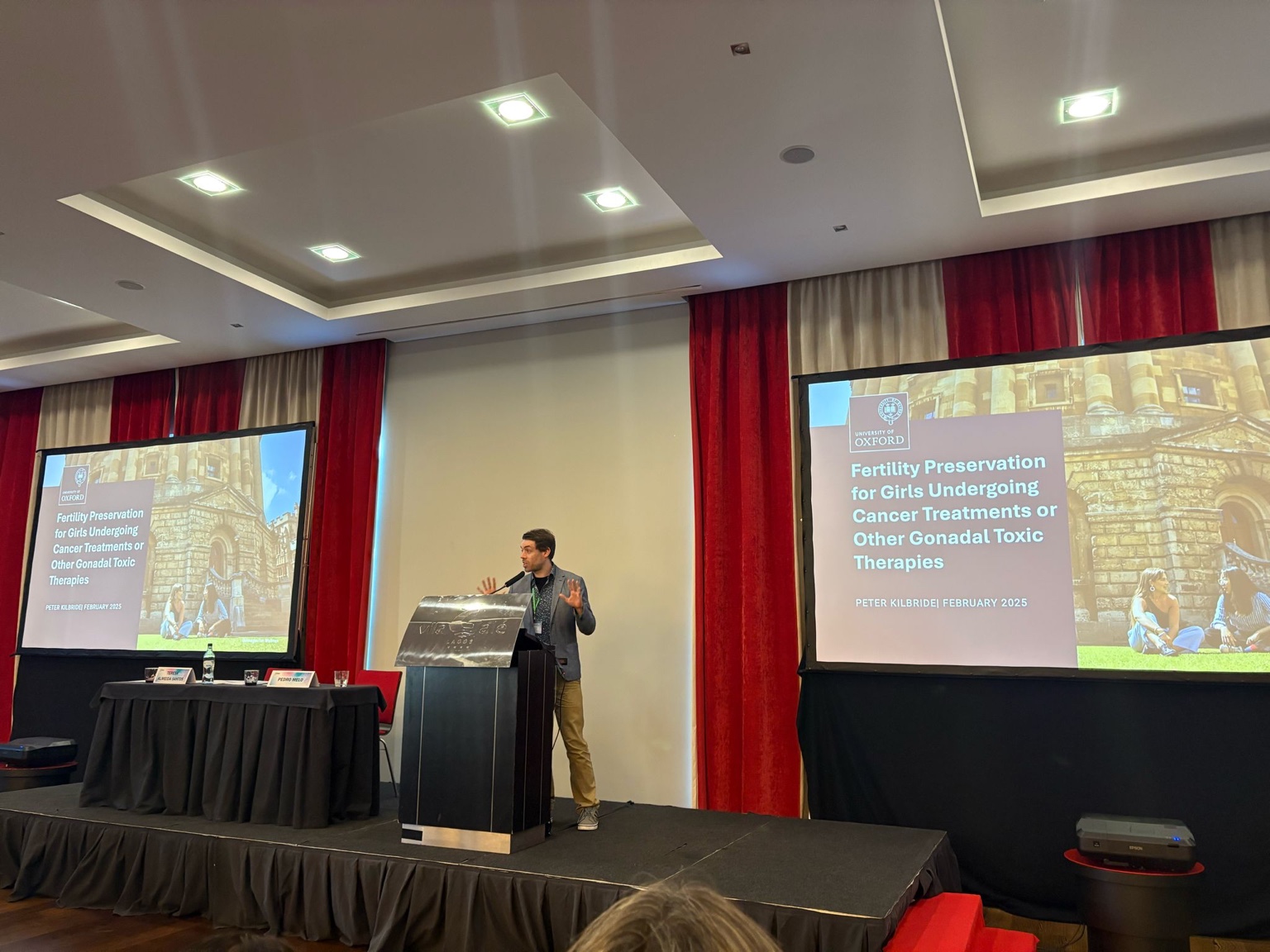
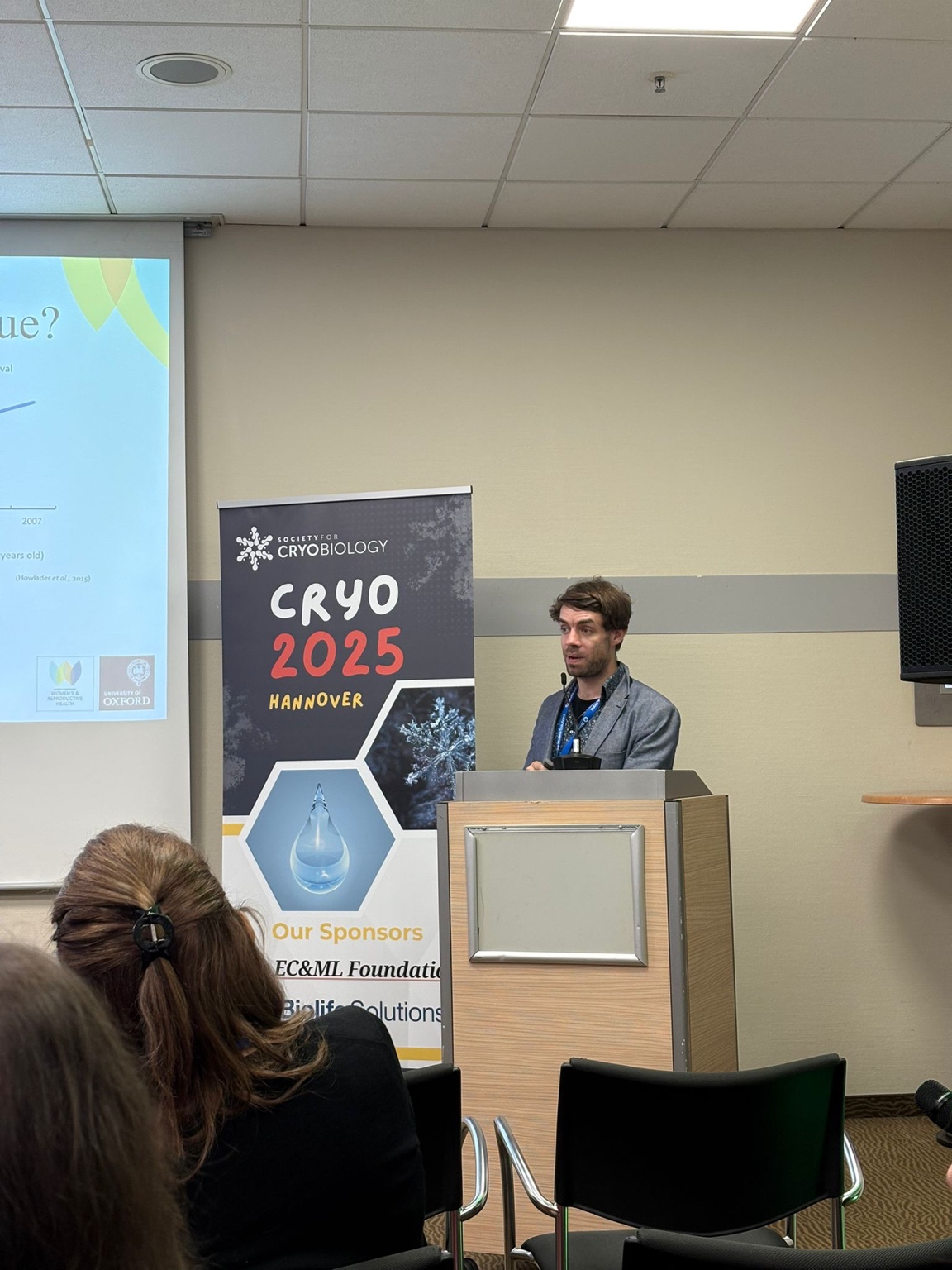
We present and discuss work across cryobiology, medicine, sustainability, conservation and translation — connecting specialist science with the people who can use it.
Recent talks & activity →


Our projects start with a real problem rather than a disciplinary boundary.
Improving how advanced therapy medicinal products (ATMPs) are frozen, stored, transported and recovered — connecting laboratory optimisation with manufacturing, clinical delivery and real-world constraints, with a particular focus on CAR-T and CAR-NK therapies.
Developing a new route for long-term institutional capital to support ambitious scientific research.
Explore Finance the Future →Bringing scientific evidence to the way organisations understand and act on nature, biodiversity and environmental systems.
Explore Global Catchment →Working with experts in ageing to explore how tissue preservation, transplantation and regenerative medicine could contribute to healthier ageing — while also bringing together perspectives from inside and outside science to ask more fundamental questions about what ageing is and where new treatments might come from.
Working with endangered species and developing ways to preserve tissues and biological material — not only to help prevent extinction, but to support biodiversity and explore how science can help reverse some of the damage already done to the natural world.
Developing better approaches to ovarian tissue cryopreservation, with particular relevance to fertility preservation for children and young people undergoing cancer treatment.
Our research record stretches back many years, across fundamental cryobiology, cell and tissue preservation, manufacturing, scale-up and clinical translation. Papers are linked directly to the relevant areas above, with the complete publication record available below.
Translation is not only about generating intellectual property. It is about recognising what is genuinely commercialisable, protecting it appropriately, and understanding the manufacturing, regulatory and business route needed to make it useful. Our experience includes around a decade in industry, inventions developed with industrial partners, and work spanning manufacturing through to FDA-facing medical-device approval.
Examples of inventions developed and protected internationally
These include technologies commercialised through previous organisations and used by major companies in the sector.
Cryopreservation method & apparatus ↗Cryopreservation apparatus & methods ↗Freezing biological samples ↗Cooling conditions for biological samples ↗We work with universities, clinicians, companies, investors and organisations looking to move ambitious science forward.